Blog Post #1
 The most interesting point that Samuel Delany makes in “About 5,750 Words” is the idea that every single word in any given text, has thorough meaning, and by changing one single word could create an entire new meaning and understanding. The main example Delany uses is by starting out with the sentence, “I put some things on the desk.” This original sentence is altered four times, with each proceeding sentence either replacing a word from the previous sentence, or introducing a new one. The second sentence switches out the word “things” with “books”. The phrase becomes much more clear, and is easier to visualize by the reader. The third sentence switches out the word “some” with “three”. The fourth introduces the word “poetry” in between “three” and “books”. The fifth and final sentence specifies what books they are, and the sentence becomes, “I put Hacker’s Presentation Piece, Ebbe Borregaard’s Sketches for Thirteen Sonnets, and Walkoski’s Inside the Blood Factory on the desk.” A rather dull phrase can increase its detail and visuality by several magnitudes, simply by changing/including one word. Not only this, but the connection to other aspects of the phrase are enhanced as well. As the sentence becomes more descriptive, a sophisticated reader may attempt to draw connections to other objects or ideas mentioned. Delany explains that as the variations become more detailed, questions about the desk arise. On the topic of words and their significance, this leads into how Delany defines science fiction. To define the genre, Delany first explains the ties to naturalistic fiction and fantasy, and how they can connect to reality. Naturalistic fiction is described as events that could happen, fantasy is described as events that cannot happen, and science fiction is described as events that have not happened. In more detail, science fiction’s connection to reality is the idea that events can be attempted to be explained in a real world context. This idea can connect to the fact that a single phrase can have wildly different meanings depending on the genre. The example Delany uses is the phrase, “winged dog”. In fantasy, it is not meant to be explained why a winged dog exists, because it is not in the nature of the genre for things to be questioned. In science fiction though, Delany explains that genetics could be taken into account, evolution and the modifications or body changes that had to happen to accurately explain why a winged dog would exist in a future world. There are both advantages and disadvantages to this approach for the definition. The main advantage is that almost all science fiction texts fall under this definition. The range of human capabilities is near limitless, and we can mostly explain all phenomena in science fiction pieces given our current knowledge and understanding of the universe. The main disadvantage of this approach is that there are aspects of science fiction that are impossible to explain. A perfect example of this is the concept of traveling faster than the speed of light. This cannot be explained because it cannot exist, something that has been proven in our reality, but it appears to be prominent in many science fiction novels, movies, etc.
Blog Post #2
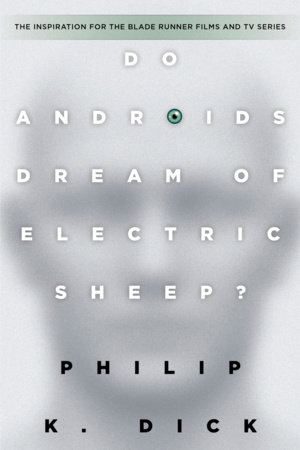
“Because, ultimately, the empathetic gift blurred the boundaries between hunter and victim, between the successful and the defeated.” (Page 29)
Blog Post #3
 One major piece of information I learned was just how long the Cold War lasted, in the sense of ideologies and motives. In Aziz Rana’s, “Goodbye, Cold War”, it is stated in the beginning that the last Cold War election held in the United States was the election of 2016, between Hillary Clinton and Donald Trump. This at first glance baffled me, because both I and millions of others know that the Cold War officially ended in 1991, 25 years prior to this election. After reading on though, it became much more clear to me just how this can be considered the last election of the Cold War. In the essay it is explained that prior to World War II, during the Great Depression, the openness of the American people to vastly different political and ideological standpoints was at its high. The nature of this was due to the failure of capitalism, which led to ideologies like communism and socialism to become quite ideal to many. This changed, though, during, and most especially after the Cold War, once the Soviet Union had collapsed. The Cold War was encapsulated around the moral battle between capitalism versus communism & socialism, and with the fall of the Soviet Union, capitalism had won in the eyes of many. In the 25 years after the ending of the Cold War, after reading this essay I can truly see now how the ideals held during the war persisted. Only recently has socialism become less of a foul taste in people’s mouths because of the constant bombardment of how capitalism triumphantly claimed victory in 1991. This challenged the belief I had, that once the Cold War ended, the political motivation of the United States had moved onto the next affair. This definitely affected the development of science fiction both during and after the Cold War as well. A writer from the United States could have written a science fiction novel right after the collapse of the Soviet Union, about the distribution of capitalism throughout the world and bringing prosperity to wherever it went. Using real world parallels like countries such as Japan or South Korea, economic powerhouses many claim as a result of American occupation and the fall or decline of soviet states. A writer from the fallen Soviet Union could have written a novel about the resurgence of communism as an inevitable decline or downfall of an uber capitalist state was underway. The vastly different ideologies as a result of the conclusion of the Cold War gave rise to many science fiction novels, even today there could be some that are being written with a Cold War background in mind.
Blog Post #4
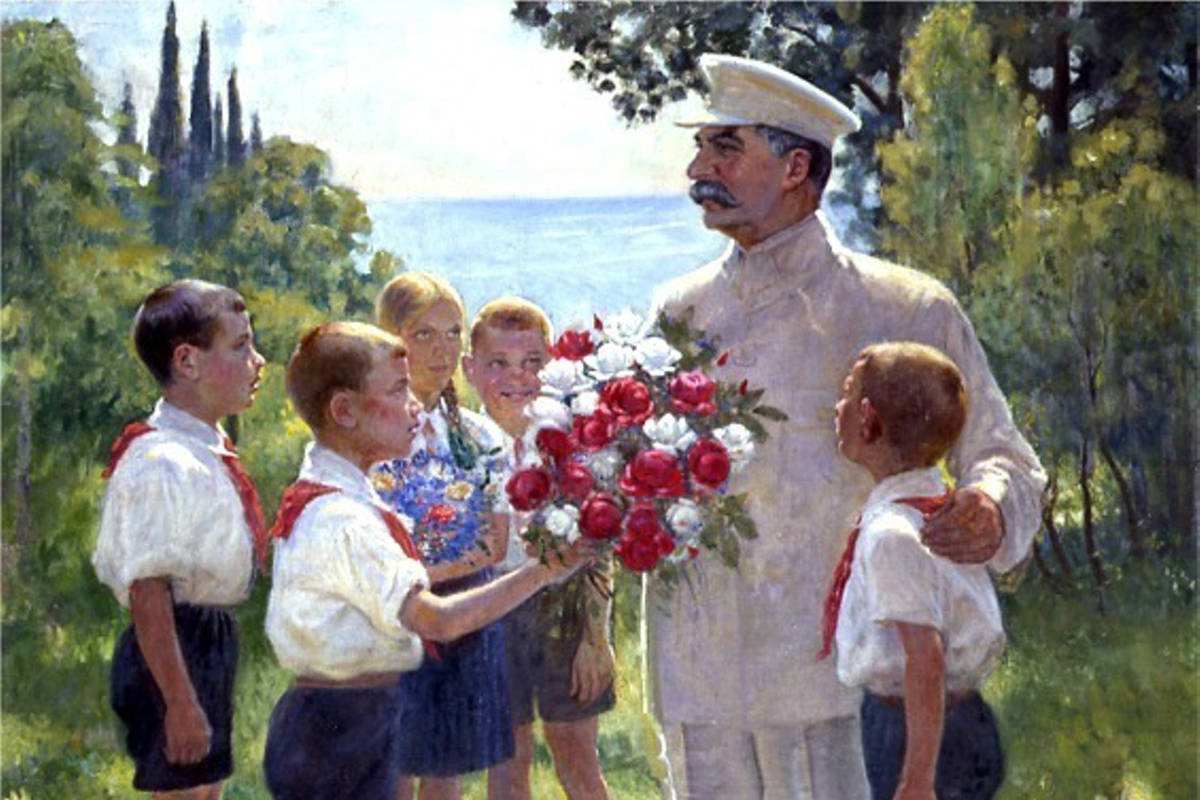 Most of the science fiction written in the Soviet Union and Soviet occupied land was literature that touched upon the positives of a socialist future, and often criticized or satirized American ideas, American culture, and capitalism. Science fiction was used as a medium to inspire those of both opposing and agreeing views with the Soviet Union the cultural, political, social, and economic advantages of socialism, as well as providing a glimpse into the future of what the ideas of the nation could do to benefit the world as a whole. An example of this is explained in Patrick Major’s, “Future Perfect? Communist Science Fiction in the Cold War”. On page 9, Major writes that some communist stories gave sight to the “peaceful applications of atomic power.” It is detailed that atomic power can provide clean energy to numerous innovations, relieve many from manual labor, and so on. This was a major contrast to American science fiction, where often atomic power was written in a much more negative context. Often the writings of a positive future regarding nuclear power in the Soviet Union was a clever way of justifying its development of warheads to match the United States’. A major component of Soviet literature, and Soviet artistic mediums as a whole was the idea of socialist realism. Socialist realism was used as a way of promoting the ideas of a utopian socialist future, where classes would be demolished and equality of the highest caliber would prevail. As explained in A. A. Zdhanov’s speech, “Soviet Literature – The Richest in Ideas, The Most Advanced Literature”, the main purpose of literature and art coming out of the Soviet Union should to be promote the advancement of socialism, and to enlighten those around the world about a utopian future, where aspects like the “parasite classes” have been abolished. Zdhanov’s final words speak volumes to the totality of his speech. He says, “Create works of high attainment, of high ideological and artistic content. Actively help to remold the mentality of people in the spirit of socialism. Be in the front ranks of those who are fighting for a classless socialist society.” This could have inspired thousands of writers in the Soviet Union and Eastern Europe to write science fiction literature in the mold that the Soviet Union is a friend, only looking to bring equality and prosperity to the world, and to bring light as to what a future like that could look like.
Blog Post #5
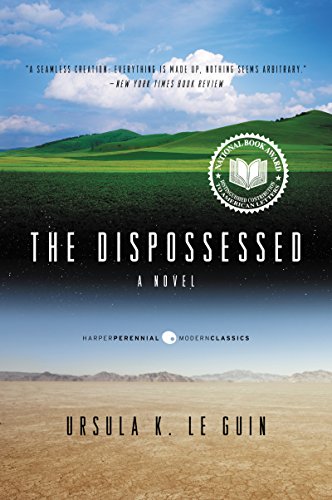 Ursula Le Guin’s novel, The Dispossessed, can be understood as science fiction or utopian literature in the sense of social critique by offering a sort of reflection on reality through the use of settings and ideas close to reality, but in a world highly different from reality. Connecting to Darko Suvin’s essay, “On the Poetics of the SF Genre”, the idea of science fiction being a reflection of reality is a core concept. Specifically in Le Guin’s novel, the aspects that are rooted in fiction are the ideas of the planets of Anarres and Urras. Whereas these two planets are all a part of the story, some examples of what happens on these planets are realistic. A prime example is in chapter seven, where a civil war in Benbili is discussed. The war is fought between the government and the rebels of the nation, and other nations like A-Io and Thu support different sides. This example of a proxy war is very realistic, and highly reflective of the time period the novel was written in. Proxy wars were extremely prominent in the Cold War and served as a prime reason as to why the Cold War was “cold”. Because of this highly reflective aspect of real life in a story quite different, ironically I feel it makes us more critical and more analytical of our own world. This leads into how at times science fiction literature can offer more than other realist literature. To answer this question I think it is best to discuss why fiction is one of the most popular genres in existence. Fiction offers an escape from reality, whether it be in stories only slightly altering the world around us, or drastically. People often search for some kind of escapism because reality can oftentimes be depressing, or too much to handle. Science fiction tends to lean towards stories that drastically differ from reality, enhancing the escape. Through this, sometimes ideas that mimic reality can be slipped in and processed more easily than say through a novel that is extremely close to reality. Because realistic literature is just that, realistic, I believe that it paradoxically fails to draw connections to real life as well as science fiction can. A world created in science fiction can exaggerate topics and ideas that are not so easily digestible. This is why political cartoons are so effective in portraying a message. The exaggerated characters and topics allow for a viewer to easily understand the indented message.
Blog Post #6
Sci-Fi’s Hugo Awards and the Battle for Pop Culture’s Soul
